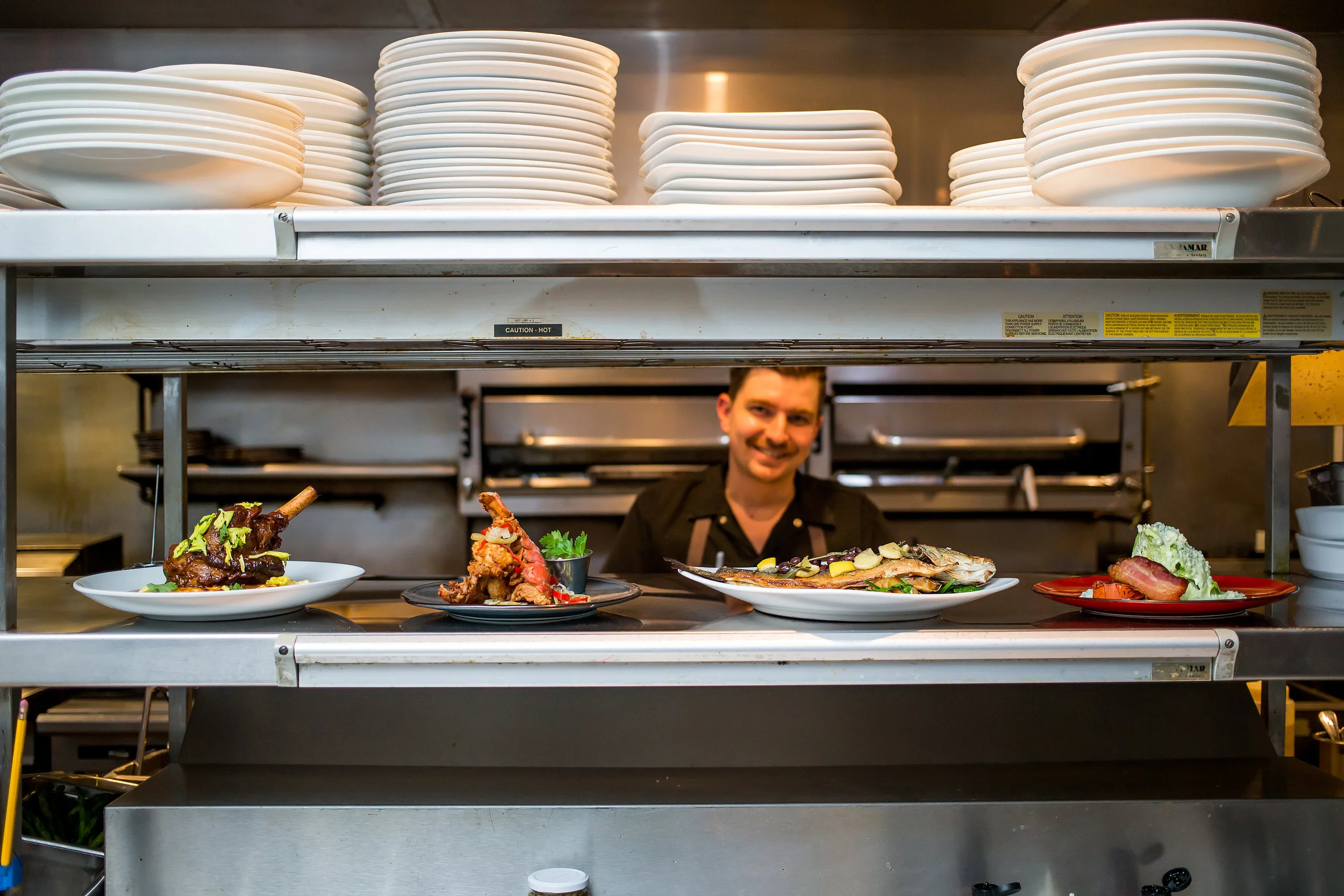
EXECUTIVE CHEF RYAN WOMBACHER
For Topaz Café’s executive chef Ryan Wombacher, cooking is the only choice. And, it’s a bit of a family affair -Wombacher grew up in the industry through his own family’s business and the business of a family friend. For nearly 50 years, Ryan’s family owned and operated a Budweiser Wholesalership in Central Illinois. Growing up with and later working for the family business gave Ryan the opportunity to experience the retail side of the restaurant industry. In 1996, as a high school freshman in Bloomington, Illinois, Ryan began working as a dishwasher at Beningo’s, a local restaurant owned by a family friend. After a couple weeks of washing dishes, Ryan moved his way up to the kitchen. Then, just a few short months later, Ryan had learned every station, discovering that he had talent, ability, and a true love of cooking. It was his boss at Beningo’s that first suggested he pursue cooking as a career. Encouraged by the owner, Ryan applied for and was accepted to Kendall College in Evanston, Illinois to pursue his passion for cooking.
During his time in culinary school, Ryan studied under many top-notch chefs and enjoyed challenging himself by participating in cooking competitions, catering events and anything else the school offered him. One of the most significant experiences during his time in culinary school was the opportunity to work for John Coletta at Caliterra in the Wyndham Chicago hotel. There, he was able to learn the art and passion of creating true seasonal menus and incorporating the freshest ingredients in California, Italian and American cuisines. Much of what Ryan learned during this time he still uses when planning his menus today.
After graduating culinary school, Ryan became the first chef of Simon Lin’s Asian Bistro in Lincolnshire, Illinois. After nine months there, he moved back downtown Chicago to work as a sous chef and later a chef de cuisine at Rhapsody and the Club at Symphony Center working under Patrick Crane and Doran Payne.
After a little over a year, Ryan decided to move on and challenge himself with a higher quality and level of fine dining at Boka. There, he was truly able to exceed and step out of a sous chef and chef de cuisine role. While at Boka, Ryan wrote and executed an ever evolving menu under the watchful eye of Guisseppe Scurato and helped to open Landmark Grill.
In the Summer of 2005, Wombacher was approached by a friend about working with a mutual friend in Lousiville, Kentucky at what would become Ryan’s first true executive chef job. After visiting Kentucky, Ryan fell in love with the locale, the restaurant, the town and the opportunity. For six months Ryan was the chef of North End Café, a small farm-to-table café serving breakfast, lunch and dinner. During this experience, Ryan realized that his passion was to focus on dinner and fine dining and went to work at 610 Magnolia, one of the true fine dining/supper clubs of Louisville. Working with the farmers from Kentucky and Southern-Indiana along with the southern artisanal companies Ryan developed a love of southern cooking that continues to shape his current flavor and style of Contemporary-American cuisine today.
In the Spring of 2008, Ryan was offered the opportunity to come back to Chicago and work at Topaz Café in Burr Ridge, Illinois, part of the Gemstone Café group of restaurants, as sous chef. His experience with Topaz earned him the opportunity to be the opening chef of Gemstone Café Group’s Dolce’s Pizzeria in Westmont, Illinois in 2009 and Ryan rose to the Executive Chef position at Topaz Café later that year. Now Ryan is in his current roll as Corporate Chef of Gemstone Café Group’s three restaurants: Topaz Café, Amber Café and Dolce’s Pizzeria and enjoys working with his two good friends, Amber Café chef Andrew Sikkelerus and owner Branko Palikuca who continue to make his job even more fun, motivating and rewarding each and every day.
Topaz's Golden Boy Dishes His Organic Beginnings
by Christopher Brinckerhoff, Burr Ridge Patch, October 13, 2010
Ryan Wombacher, Executive Chef at Topaz Cafe in Burr Ridge, speaks about his training, development and philosophy. When patrons dine at Topaz Café during the summer, they are likely to see specials that incorporate fresh fruits and vegetables from Burr Ridge's farmers market.
Ryan Wombacher, executive chef at Topaz, lends an organic and sustainable sensibility to his menu. For the 29-year-old Chicago native, serving fresh and natural food isn't about being trendy, it's about taste - and fresh simply tastes better. Wombacher recently released the fall menu at Topaz, which he changes seasonally, and it includes a cornucopia of harvest colors and flavors.
The chef recently spoke with Patch about his entry into the culinary arts, his development as a chef and what he's passionate about.
Patch: How did it come to be that you were interested in the culinary arts and where did you train?
Wombacher: It's an interesting story. I was looking for a part-time job when I was in high school. My best friend's mom had an Italian restaurant, Beningo's, that's still open today, and I started off washing dishes there on Friday and Saturday nights.
Then a couple weeks later, next thing I'm watching my buddy's brother make pizzas and I'm making pizzas. I'm working pastas, and I'm doing the fryer, the grill, I'm learning everything all within a couple months. And my buddy's mom was just like 'you got a real talent for this, you should pursue it.' I worked there all through high school - every Friday and Saturday night, and rotated there on Sundays.
P: You went to culinary school at Kendall College and worked at a number of restaurants, including Rhapsody in Chicago, before becoming chef de cuisine at Boka Restaurant. What happened after Boka?
W: In August 2006, I took a chance. I decided I was going to move to Louisville, KY. I got offered an executive chef position at a little mom-and-pop style café: breakfast, lunch and dinner, but focusing on organic and local markets and everything like that. It was North End Café.
P: Where did you go next?
W: In 2007 I started working at 610 Magnolia in Old Louisville. It's just south of downtown. I was there a year and a half as chef de cuisine. The supper club was only open Thursday, Friday and Saturday. It had a prix fixe menu. When I was there it was six courses with a somewhat seventh course for $75 a person.
We did everything farm to table. I had my own guys growing vegetables, I had my own guys bringing me meat. From one farmer I was getting organic pork, organic chicken, lamb and beef. So it was really cool. And then, the last year I was there, we had just gotten a kid who started growing vegetables. We'd buy the seeds and he'd grow the vegetables for us, and we'd have it all the way through the season.
P: Then what changed?
W: In August 2008 I got a call from Giuseppe Scurato (Wombacher's old boss at Boka); they opened up Topaz. Giuseppe said 'I need a good sous chef.' He's like 'if you ever want to come back to Chicago I got a job for you.' I was like, all right, fine. I moved back here.
P: Giuseppe has since left Topaz, and now you're applying your desire for organic and seasonal foods to its menu. What does that mean for you?
W: One of my servers asked me if it's just about the theme of going organic. I was like no, when I was in Louisville I really learned what it is to be organic and to be sustainable. When you taste a real cherry tomato grown by a person [who doesn't use] pesticides, that's completely different than buying a cherry tomato from a chain grocery store. That's what food is to me.
Can you imagine if you have beef, real beef, or real pork? I was getting whole pigs. If you get a pork loin from an organic pig, when you look at the pork loin on its end there's layers of fat just like a real animal, like if you went hunting. If you look at the one from the grocery store there's never any fat in the meat. It's all on the top; that's it, because they raise them to be like this.
P: So can you taste the difference?
W: If you have chicken that tastes like chicken, you can taste the dirt that they ate, the grass that they ate. We were messing around before I left (Louisville). We were feeding a pig - like they do in Spain - all of our vegetable scraps, feeding him nuts and pinecones the last three months the pig was alive just to see how it'd change the flavor. And you could taste it. It was a cleaner. If they ate a lot of chives you could taste the chives in it. You could taste all the herbs and all the onion peels.
P: You mentioned the lamb sausage on the restaurant's menu is one of your favorite dishes. Why do you enjoy it so much?
W: I make the lamb sausage myself. The funny thing is, when we first opened, we had a lamb sausage that we bought from Wisconsin. Availability became less, and people just loved the lamb sausage. Instead of dealing with it, I remembered the flavors of it, I was just like, you know what - I'm going to make my own.
P: Is it difficult to make your own sausages?
W: It's a challenge. I have to sit there and it takes me two hours to make 40 orders of sausage from scratch. I get the ground meat and everything, I mix it. I let it sit for a couple hours or overnight. Then I take it, and by hand, stuff it into the old fashioned stuffers. And then I let it sit for a day.
It's quality of product. I know exactly what it is. People have the hesitation, 'oh, sausage is like hotdogs, you don't know what's in it; it's a mystery.' Well I know exactly what's in my sausage. I know there's ground pork and ground beef. I'm using ground chuck; I'm using ground lamb shoulder. So I know exactly what it is. I know the spices I put into it. I know if I put preservatives in it, which the only thing I put into it is curing salt which helps keep the color.
P: Is there a special, seasonal sausage on the fall menu?
W: I was thinking for the fall menu I want to do an Italian sausage. I have these cool cast iron pans. I want it to come to you with this piece of sausage and these peppers and onions and garlic and everything just sizzling with white wine. So you just want to take your bread and just dip into it. That kind of stuff excites me more than a piece of filet with mashed potatoes. That stuff is boring to me.
Quality is always important, that's what cooking is. Every plate that I put out is a business card; it's a representation of me.